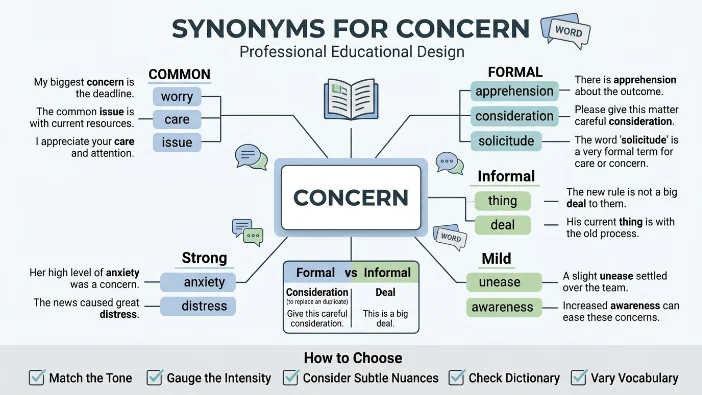
Concern is one of those words we use constantly. But sometimes, it doesn’t quite fit. The water shortage concerns us all. I have a concern about the project timeline. She runs a successful business concern. The best synonyms for concern are worry, care, interest, anxiety, issue, matter, affair, and company. The right choice depends on tone, context, and intensity.
This guide covers the most useful synonyms for concern from formal alternatives for business writing to casual words for everyday conversation. You’ll learn which words to use when, and which to avoid.
Best Synonyms for Concern
The best synonyms for concern depend on how you’re using the word:
- As a feeling of worry: worry, anxiety, unease, apprehension, disquiet
- As something important: issue, matter, affair, consideration, interest
- As care for someone: solicitude, regard, thoughtfulness
- As a business: company, firm, enterprise, corporation
- As a verb meaning to relate to: involve, affect, pertain to, touch
The examples and context sections below will help you choose the perfect word every time.
What Does Concern Mean?
Concern has several related meanings :
As a noun:
- A feeling of worry, anxiety, or care about something
- Something that is important or affects a person
- A matter that requires attention
- A business or company
As a verb:
Simple examples:
- “Her health is my main concern.” (worry)
- “This matter does not concern you.” (relate to)
- “He works for a large concern.” (company)
Concern carries a sense of importance. When you’re concerned about something, it matters to you. The word can express anything from mild interest to deep anxiety.
Core Meaning of Concern
At its heart, concern means that something matters. It’s about connection whether that connection is emotional, practical, or professional.
- When you feel concern for someone, you care about their well-being.
- When a matter is your concern, it’s your responsibility or something that affects you.
- When a business is a concern, it’s an enterprise people are involved in.
The word sits at the intersection of emotion and practicality. It can describe both how you feel and what needs attention.
Core aspects of concern:
- Importance or significance
- Emotional investment (worry, care, interest)
- Connection to a person or situation
- Relevance or bearing on something
Grammar and Usage Notes
Part of speech: Concern can be a noun or a verb.
Noun uses:
- “My concern is…” (something important)
- “I have concerns about…” (worries)
- “That’s not my concern.” (responsibility)
- “A large concern” (company)
Verb uses:
- “This concerns you.” (affects you)
- “I concern myself with…” (involve myself)
- “The news concerns…” (is about)
Common collocations:
- Express concern
- Show concern
- Voice concern
- Raise concerns
- A matter of concern
- Cause for concern
- Of great concern
- Concern for someone/something
When concern sounds natural:
- When discussing worries or anxieties
- When talking about things that matter to people
- When something is relevant to a situation
- In both formal and casual contexts
When a synonym may work better:
- When you need a stronger emotional word
- When you want to sound more formal or academic
- When you need a casual alternative for conversation
- When you want to avoid repetition
Best Synonyms for Concern
| Synonym | Meaning | Tone | Best Use Case | Example Sentence |
|---|---|---|---|---|
| Worry | Anxious feeling about something | Neutral | Everyday conversation | “Her constant worry about money is exhausting.” |
| Anxiety | Strong nervousness or unease | Formal/Strong | Professional/emotional contexts | “His anxiety about the presentation was visible.” |
| Issue | A matter or problem | Neutral | Professional, everyday | “The budget issue needs immediate attention.” |
| Matter | A subject or situation | Formal | Business, legal, official | “This matter requires your signature.” |
| Care | Serious attention or concern | Warm/Thoughtful | Emotional contexts | “She shows genuine care for her students.” |
| Interest | Curiosity or importance | Neutral | Intellectual contexts | “The topic holds great interest for researchers.” |
| Unease | Mild discomfort or worry | Mild | Cautious situations | “She felt a growing unease about the decision.” |
| Apprehension | Fear about something coming | Formal | Future-oriented worries | “He felt apprehension before the meeting.” |
| Disquiet | Restlessness or anxiety | Literary/Formal | Formal writing | “Public disquiet about the policy is growing.” |
| Solicitude | Care or concern for someone | Literary/Formal | Showing kindness | “Her solicitude for the older was admirable.” |
| Firm | A business company | Formal | Professional contexts | “He works for a well-known law firm.” |
| Enterprise | A business project or company | Formal/Business | Commercial contexts | “She runs a successful enterprise.” |
| Affair | A matter or event | Formal | Official/business contexts | “The government mishandled the whole affair.” |
| Consideration | Something to think about | Formal | Decision-making | “Cost is a major consideration.” |
| Perturb | To worry or disturb | Formal/Strong | Emotional contexts | “The news did not perturb him.” |
Common Synonyms for Concern
These everyday synonyms work in normal conversation and casual writing.
Worry
Meaning: A feeling of anxiety or unease about something that might happen.
Best context: Casual conversation, personal situations. Use when you want to describe emotional distress without being too formal.
Example: “My main worry right now is finishing this project on time.”
Issue
Meaning: An important topic or problem that needs attention.
Best context: Professional settings, problem-solving, general discussion. Good for neutral, practical language.
Example: “The safety issue was addressed in the meeting.”
Interest
Meaning: Curiosity about or attention to something.
Best context: Intellectual or professional topics. Use when concern is positive rather than anxious.
Example: “She has a deep interest in environmental science.”
Matter
Meaning: A subject, situation, or affair.
Best context: Formal but usable anywhere. A safe, neutral choice.
Example: “It’s a private matter, so I won’t discuss it.”
Care
Meaning: Serious attention, concern, or affection.
Best context: Emotional or professional contexts showing attention and responsibility.
Example: “He handles the accounts with great care.”
Formal Synonyms for Concern
For academic writing, business reports, essays, and professional communication, these words add sophistication.
Apprehension
Meaning: Anxiety or fear about a future event.
Best context: Formal writing about uncertainty or fear. Stronger than mild worry.
Example: “The announcement caused apprehension among investors.”
Solicitude
Meaning: Care or concern for someone’s welfare.
Best context: Literary or formal writing expressing kindness or thoughtfulness.
Example: “Her solicitude for the homeless population is well known.”
Disquiet
Meaning: A feeling of worry, anxiety, or unease.
Best context: Journalism, academic writing, literature. More formal than “unease.”
Example: “Public disquiet about the environmental impact continues to grow.”
Perturbation
Meaning: The state of being anxious or unsettled.
Best context: Academic or highly formal writing.
Example: “The perturbation in financial markets was significant.”
Consideration
Meaning: A factor to be considered; something important.
Best context: Business writing, decision-making contexts.
Example: “Employee safety is a primary consideration.”
Relevance
Meaning: The quality of being important or connected.
Best context: Formal writing, academic contexts.
Example: “The research has great relevance to modern medicine.”
Bearing
Meaning: Relevance or influence on something.
Best context: Formal discussions, reports.
Example: “This evidence has no bearing on the case.”
Informal Synonyms for Concern
These casual alternatives work well in conversation, social media, personal messages, and friendly writing.
Thing
Meaning: A matter or issue.
Best context: Very casual conversation.
Example: “My main thing right now is finding a new apartment.”
Deal
Meaning: A situation, matter, or arrangement.
Best context: Casual conversation, informal settings.
Example: “What’s the deal with the new policy?”
Bag
Meaning: Someone’s area of interest or responsibility.
Best context: Slang, informal.
Example: “That’s not really my bag.”
Headache
Meaning: A source of worry or annoyance.
Best context: Casual conversation, complaining or venting.
Example: “The car repairs are becoming a real headache.”
Bugbear
Meaning: A persistent source of irritation or worry.
Best context: Lighthearted complaints.
Example: “Late deliveries are my biggest bugbear.”
Hang-up
Meaning: An emotional concern or worry.
Best context: Casual conversation, psychological contexts.
Example: “She has a hang-up about public speaking.”
Strong Synonyms for Concern
These words carry more emotional weight. Use them when you want to express intense feeling or emphasize seriousness.
Distress
Meaning: Extreme anxiety, sorrow, or suffering.
Best context: Serious emotional situations, health contexts.
Example: “The family’s distress was visible at the trial.”
Agitation
Meaning: Nervousness or anxiety that causes restlessness.
Best context: Psychological states, conflict situations.
Example: “His agitation grew as the deadline approached.”
Apprehension
Meaning: Strong fear about future events.
Best context: High-stakes situations, legal contexts.
Example: “The defendant felt apprehension before the verdict.”
Consternation
Meaning: Amazement or dismay that causes confusion.
Best context: Surprising or shocking situations.
Example: “The announcement caused consternation among employees.”
Alarm
Meaning: Fear or anxiety caused by danger.
Best context: Emergency situations, warnings.
Example: “The doctor’s words filled her with alarm.”
Mild Synonyms for Concern
These softer words are gentler and more neutral. Use them when strong language would sound excessive.
Unease
Meaning: A mild feeling of discomfort or worry.
Best context: Subtle worries, cautious situations.
Example: “She felt a slight unease about the job offer.”
Interest
Meaning: Curiosity or engagement.
Best context: When concern is positive rather than anxious.
Example: “The research holds great interest for scientists.”
Thought
Meaning: Consideration or attention.
Best context: Neutral, gentle language.
Example: “We’ll give some thought to that idea.”
Awareness
Meaning: Knowledge or concern about something.
Best context: Social or political contexts.
Example: “Awareness of the issue has grown.”
Regard
Meaning: Consideration or attention.
Best context: Formal but gentle.
Example: “She has great regard for her colleagues.”
Mindfulness
Meaning: Conscious attention or concern.
Best context: Health, wellness, self-improvement.
Example: “Mindfulness of your mental health is important.”
Synonyms for Concern by Context
Everyday Conversation
In casual talk, you’re likely to use worry, issue, or care.
- “My biggest worry is that we’ll be late.”
- “The issue with the car is the brakes.”
- “I don’t have much care about the details.”
Worry is the most natural choice when expressing anxiety. Issue works for problems or topics. Care can express interest or responsibility.
Professional Writing
In business contexts, opt for issue, consideration, matter, or interest.
- “The budget is our primary consideration.”
- “This matter requires your immediate attention.”
- “Employee satisfaction is a matter of great interest.”
Consideration sounds more strategic. Matter has a formal, official feel. Issue is direct and practical.
Academic Writing
Use relevance, bearing, pertinence, or application.
- “The theory has great relevance to this field.”
- “This variable has no bearing on the outcome.”
- “The pertinence of the study is clear.”
These words signal intellectual precision and careful thought.
Creative Writing
For emotional depth, use solicitude, disquiet, yearning, or care.
- “His eyes held a deep solicitude for the child.”
- “An underlying disquiet settled in her heart.”
- “She yearned to ease his concerns.”
These words add texture and emotional weight to characters and situations.
Marketing Copy
To engage readers, use interest, consideration, relevance, or priority.
- “Customer satisfaction is our top priority.”
- “Health is a consideration for every modern consumer.”
- “This product addresses your key concerns.”
Priority shows commitment. Relevance connects with the audience.
Emotional Expression
For genuine feeling, use anxiety, distress, solicitude, or compassion.
- “His anxiety about the future was overwhelming.”
- “She showed compassion for the grieving family.”
- “Their distress was heartbreaking to witness.”
Anxiety conveys intense worry. Compassion shows caring for others.
Technical Writing
Precision matters. Use applicability, bearing, relevance, or impact.
- “The findings have direct applicability to safety protocols.”
- “This variable’s impact on the system is minimal.”
- “The bearing of these results is significant.”
Applicability and impact are clear and measurable.
Personal Communication
Use care, worry, interest, or thought.
- “I care about your health.”
- “My worry is that you’re overworking.”
- “The thought occurred to me that we might be wrong.”
Care expresses warmth. Worry shows concern without being clinical.
Another Word for Concern in a Sentence
Here are realistic examples using different synonyms for concern:
- Worry – “His constant worry about job security was affecting his sleep.”
- Anxiety – “The anxiety in the room was palpable before the announcement.”
- Issue – “The housing issue has become a major talking point in the election.”
- Matter – “This is a matter we cannot afford to ignore.”
- Care – “The children showed great care for the stray kitten.”
- Interest – “The professor has a genuine interest in his students’ success.”
- Unease – “She couldn’t shake the unease she felt walking home alone.”
- Apprehension – “The soldiers felt apprehension before the mission.”
- Solicitude – “His solicitude for his older mother was touching.”
- Affair – “The whole affair was handled poorly by management.”
- Consideration – “Location is a key consideration for any new business.”
- Disquiet – “Public disquiet over the policy continues to mount.”
- Enterprise – “The enterprise expanded into three new markets.”
- Care – “He handles delicate situations with care.”
- Regard – “Her high regard for the team was evident in her words.”
Concern Synonyms Compared
| Synonym | Meaning | Tone | Intensity | Best Context |
|---|---|---|---|---|
| Worry | Anxious feeling about possible problems | Neutral | Moderate | Everyday concerns |
| Anxiety | Unpleasant nervousness | Formal | Strong | Psychological/emotional states |
| Care | Serious attention and concern | Warm | Moderate | Relationships, responsibility |
| Solicitude | Care for someone’s welfare | Formal/Literary | Strong | Showing kindness |
| Interest | Curiosity or engagement | Neutral | Mild | Intellectual pursuits |
| Apprehension | Fear of the future | Formal | Strong | Future-oriented worries |
| Issue | A problem or topic | Neutral | Neutral | Professional settings |
| Matter | A subject or affair | Formal | Neutral | Official contexts |
| Disquiet | Unease or anxiety | Formal/Literary | Moderate | Formal writing |
| Unease | Mild discomfort | Neutral | Mild | Subtle concerns |
Worry is the everyday choice it’s the most natural for most situations. Anxiety is stronger and often clinical. Apprehension is formal and future-oriented. Unease is mild and less urgent.
Words Similar to Concern
These words are related to concern but aren’t exact synonyms. They belong to the same semantic field.
Preoccupation – When you’re deeply concerned about something to the point of distraction.
- “His preoccupation with work damaged his relationships.”
- Use when concern becomes all-consuming.
Disturbance – Something that disrupts peace or causes worry.
- “The disturbance in the neighborhood worried residents.”
- Use when concern involves disruption.
Responsibility – A duty or obligation that involves care.
- “Managing the budget is his responsibility.”
- Use when concern is about obligations rather than emotions.
Empathy – Understanding and sharing another’s feelings.
- “Her empathy for struggling students is genuine.”
- Use when concern is about understanding others.
Mindfulness – Awareness and attention to something.
- “Mindfulness of your surroundings is important.”
- Use when concern is about conscious attention.
Antonyms of Concern
These words express the opposite of concern lack of care, worry, or interest.
| Antonym | Meaning | Example Sentence |
|---|---|---|
| Indifference | Lack of interest or concern | “Her indifference to the problem was alarming.” |
| Unconcern | Lack of worry or interest | “He treated the warning with unconcern.” |
| Neglect | Failure to care for something | “The neglect of the building was obvious.” |
| Disregard | Lack of attention or respect | “His disregard for safety caused the accident.” |
| Apathy | Lack of interest or emotion | “Voter apathy is a growing concern.” |
| Calm | Peaceful state, free from worry | “She felt calm about the outcome.” |
| Tranquility | Peacefulness, serenity | “The tranquility of the countryside soothed her.” |
| Ease | Absence of worry or difficulty | “He handled the situation with ease.” |
Indifference is the most direct antonym for concern as a feeling. Neglect opposes concern as a verb meaning to care for. Calm and tranquility oppose concern as a state of worry.
How to Choose the Right Synonym for Concern
Picking the right word doesn’t have to be complicated. Ask yourself these questions:
What context am I writing in?
- Formal → Use apprehension, matter, consideration, relevance
- Casual → Use worry, issue, thing, care
- Professional → Use concern, issue, consideration, interest
What tone do I want to strike?
- Neutral → Concern, issue, matter, interest
- Warm → Care, solicitude, thoughtfulness
- Strong → Anxiety, distress, alarm, perturbation
- Mild → Unease, awareness, regard, mindfulness
What’s the intensity level?
- Mild → Unease, interest, awareness
- Moderate → Worry, care, disquiet
- Strong → Anxiety, distress, alarm, consternation
What am I trying to convey?
- Emotion → Worry, anxiety, care, solicitude
- Importance → Matter, issue, consideration, priority
- Relevance → Bearing, relevance, pertinence
- Business → Firm, company, enterprise, corporation
Who is my reader?
- General audience → Keep it simple: worry, issue, care
- Professional readers → Consideration, matter, interest
- Academic readers → Relevance, pertinence, bearing
Is the synonym exact or only related?
If it’s only related, use it carefully. Some related words are only appropriate in specific contexts.
Common Mistakes When Using Synonyms for Concern
Even experienced writers make these mistakes. Here’s what to watch out for:
Using a word that’s too strong
- ✗ “The food quality is a source of distress.” (sounds dramatic)
- ✓ “The food quality is a concern.” (more appropriate)
Using a synonym with the wrong tone
- ✗ “His solicitude for the budget was obvious.” (too formal for business)
- ✓ “His concern for the budget was obvious.”
Mixing formal and informal in the wrong context
- ✗ “The company’s main thing is customer satisfaction.” (too casual in a report)
- ✓ “The company’s primary concern is customer satisfaction.”
Using related words as exact synonyms
- ✗ “His preoccupation for her safety was touching.” (preoccupation isn’t quite right)
- ✓ “His concern for her safety was touching.”
Using “anxiety” when you mean mild worry
- ✗ “I had some anxiety about the menu.” (too strong)
- ✓ “I had some concern about the menu.”
Making sentences sound unnatural
- ✗ “The matterment of the issue is paramount.” (doesn’t exist)
- ✓ “The matter requires our attention.”
Overusing “issue” in place of “concern”
- ✗ “The main issue is her health.” (correct but overused)
- ✓ “Her health is a matter of concern.” (more varied)
Quick Synonym List for Concern
Common Synonyms
- Worry
- Care
- Interest
- Issue
- Matter
Formal Synonyms
- Apprehension
- Consideration
- Solicitude
- Disquiet
- Relevance
- Bearing
- Pertinence
Informal Synonyms
- Thing
- Deal
- Bag
- Headache
- Hang-up
- Bugbear
Strong Synonyms
- Distress
- Anxiety
- Alarm
- Agitation
- Consternation
- Perturbation
Mild Synonyms
- Unease
- Awareness
- Regard
- Thought
- Mindfulness
Related Words (Not Always Exact Synonyms)
- Preoccupation
- Responsibility
- Empathy
- Awareness
- Attention
FAQs
What is the best synonym for concern?
The best synonym depends on how you’re using the word.
- For a feeling of worry, worry and anxiety are excellent choices.
- For something important, issue and matter work well.
- For a business, company or firm is best.
There’s no single “best” word it always depends on context.
What is another word for concern as a verb?
As a verb, concern can mean “to relate to” or “to worry.” Synonyms include involve, affect, pertain to, and touch (for relating to). For causing worry, synonyms include worry, trouble, disturb, perturb, and bother.
What is a formal synonym for concern?
Formal synonyms for concern include: apprehension, consideration, solicitude, disquiet, relevance, pertinence, and bearing. These work well in academic writing, business reports, and professional communication.
What is an informal synonym for concern?
Informal synonyms include: thing, deal, bag, headache, hang-up, and bugbear. Use these in conversation, personal messages, and casual writing.
What is a stronger word for concern?
Stronger words for concern include: anxiety, distress, alarm, consternation, agitation, and perturbation. These express more intense emotions and are appropriate for serious situations.
What is a milder word for concern?
Milder words include: unease, interest, awareness, regard, thought, and mindfulness. These are gentler and express less urgent or intense concern.
What words are similar to concern?
Similar words include: preoccupation, responsibility, empathy, awareness, and attention. These words belong to the same semantic field but don’t always work as direct replacements.
What is the opposite of concern?
The opposite of concern is indifference . Other opposites include unconcern, neglect, disregard, apathy, calm, and tranquility.
How do I choose the right synonym for concern?
Consider your context, tone, and intensity. Ask yourself: Am I writing formally or casually? Am I expressing mild interest or deep worry? What’s the situation? Match your word to these factors, and you’ll rarely go wrong.
Conclusion
Concern has many synonyms because it means many things. It can be a feeling of worry, a matter of importance, a business, or an action. The best word for your sentence depends on what you’re trying to say.
- For everyday worries, use worry, care, or issue.
- For formal contexts, reach for apprehension, consideration, or solicitude.
- For stronger emotions, anxiety and distress work.
- For milder feelings, unease and awareness are better choices.
When in doubt, think about your reader and the situation. Keep it natural. Choose words that feel right in the sentence. And don’t be afraid to use “concern” itself it’s a perfectly good word.
The beauty of a rich vocabulary is having options. Now you have the options. Use them wisely.
Read More Related Articles:
- Synonyms for Progress | Smarter Words to Show Growth In 2026
- Synonyms for Naive | Improve Your English Fast In 2026
- Synonyms for Adorable | Better Words to Express Sweetness In 2026

Grace Phillips contributes content to SynonymsAura.com, where she writes about language, vocabulary and everyday communication. Her work is centered on helping readers find the right words and express themselves with greater clarity and confidence.