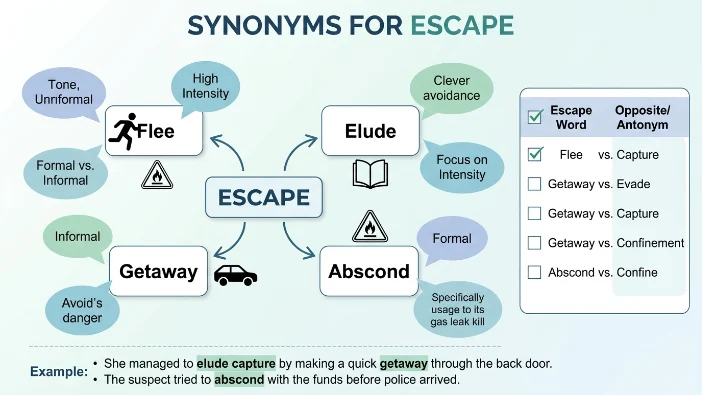
The best synonyms for escape are flee, elude, getaway, breakout, and leak. The right choice depends on whether you are describing a physical breakout, avoiding a threat, leaking a substance, or seeking mental relief. This guide explores the rich variety of synonyms for escape, helping you choose the perfect word for any context.
Best Synonyms for Escape
The best synonyms for escape are flee, elude, evade, and getaway. However, the ideal word depends on your specific meaning. Use flee for a hasty retreat, elude for clever avoidance, evade for dodging a pursuer or question, and getaway for a successful flight from a scene .
What Does Escape Mean?
At its core, escape means to break free from confinement, control, or an unpleasant situation. It can also mean to successfully avoid something dangerous or unwanted . “Escape” functions as both a verb and a noun .
As a verb, it can describe a prisoner breaking out of jail, a person avoiding injury, or even gas leaking from a pipe. As a noun, it refers to the act of escaping itself, a means of getting away, or a form of mental distraction .
- The prisoner managed to escape from his cell.
- Reading provides a welcome escape from the daily grind.
Core Meaning of Escape
The core idea behind “escape” is liberation and avoidance. It is the act of moving from a state of confinement, danger, or unpleasantness to one of freedom or safety. This can be a physical action, like escaping a burning building, or a mental one, like escaping into a good book . The feeling is often one of relief, urgency, or joy at having gotten away .
Grammar and Usage Notes
Escape” is a versatile word.
- Part of Speech: Verb and noun .
- Common Verb Patterns: It is often used with prepositions like “from” (escape from prison) and “to” (escape to the countryside). It can also be transitive, taking a direct object (escape capture, escape notice) .
- Common Phrases and Collocations: Narrow escape, escape route, escape artist, escape clause, fire escape .
- When to Use: “Escape” sounds natural in most contexts, from formal reports to everyday conversation.
- When a Synonym Works Better: While “escape” is broad, you might choose a more precise synonym. “Abscond” is better for a criminal fleeing, “dodge” is more vivid for avoiding a physical object, and “diversion” is clearer for a hobby that provides relief .
Best Synonyms for Escape
This table shows the best synonyms for escape, their meanings, and the ideal contexts for using them .
Common Synonyms for Escape
These everyday synonyms are used in normal writing and conversation .
Get Away
- Short Meaning: To succeed in escaping .
- Best Context: General use for any form of escape.
- Example Sentence: “We managed to get away from the crowded city for the weekend.”
Run Away
- Short Meaning: To leave a place or person suddenly and secretly .
- Best Context: Running from home, responsibility, or a pursuer.
- Example Sentence: “The child threatened to run away from home.”
Avoid
- Short Meaning: To stay clear of or prevent something from happening .
- Best Context: Preventing a negative event or encounter.
- Example Sentence: “He took a different route to avoid the traffic.”
Break Free
- Short Meaning: To escape from confinement or a restrictive situation .
- Best Context: Breaking from a physical or mental constraint.
- Example Sentence: “She wanted to break free from her boring routine.”
Dodge
- Short Meaning: To move quickly to avoid someone or something .
- Best Context: Avoid a physical blow or a difficult question.
- Example Sentence: “He had to dodge the flying debris.”
Formal Synonyms for Escape
These alternatives are suitable for academic, business, and professional communications .
Abscond
- When to use: Use “abscond” to describe a person who leaves hurriedly and secretly, especially to avoid the law or to escape with stolen goods. It implies guilt and a desire to avoid capture .
- Example: The cashier attempted to abscond with the weekly earnings.
Circumvent
- When to use: Use “circumvent” to describe finding a way around an obstacle or rule. It suggests cleverness and strategy in avoiding a problem without directly confronting it .
- Example: The company found a way to circumvent the new import tariffs.
Elude
- When to use: Use “elude” when someone or something skillfully avoids detection or capture. It can also be used for an idea that someone cannot grasp .
- Example: The answer to the complex equation continued to elude the mathematicians.
Evade
- When to use: Use “evade” to describe avoiding a duty, question, or pursuer through cleverness or trickery. It often has a slightly negative connotation .
- Example: The politician artfully evaded the question about the budget deficit.
Decamp
- When to use: Use “decamp” to describe a group of people suddenly and quickly leaving a place .
- Example: The protestors were ordered to decamp from the square.
Informal Synonyms for Escape
These casual alternatives are perfect for conversation, social media, and personal messages .
Take Off
- Tone and Use: A very common informal way to say someone left quickly.
- Example: “She took off as soon as the meeting ended.”
Make a Run for It
- Tone and Use: Used to describe an attempt to escape a bad or dangerous situation.
- Example: “When the guard turned around, we decided to make a run for it.”
Skedaddle
- Tone and Use: A playful, old-fashioned way to say “run away.”
- Example: “I saw the angry dog and skedaddled out of there.”
Do a Runner
- Tone and Use: A British informal phrase for leaving a place to avoid trouble or payment .
- Example: “He didn’t want to pay the bill, so he did a runner.”
Fly the Coop
- Tone and Use: To leave suddenly or escape, originally used for birds escaping a cage .
- Example: “All the kids have flown the coop and gone to college.”
Strong Synonyms for Escape
These synonyms carry more emotion, power, or intensity and should be used when you need to emphasize the dramatic nature of the escape .
Break Out
- When to Use: When describing a forceful escape from a place or situation.
- Example: “The prisoners were planning to break out of the high-security facility.”
Bolt
- When to Use: To describe a sudden and frantic run to escape, like a startled horse .
- Example: “The horse bolted when it heard the loud noise.”
Liberation
- When to Use: A powerful noun that describes being set free from a state of oppression or confinement.
- Example: “The end of the war brought liberation to the occupied nation.”
Seep
- When to Use: To describe the slow, often unnoticed, escape of a liquid or gas from a container .
- Example: “Water was beginning to seep through the cracks in the wall.”
Mild Synonyms for Escape
These softer, more neutral synonyms are appropriate when “escape” might sound too dramatic .
Diversion
- When to Use: Describes an activity that distracts the mind from unpleasant thoughts or boredom.
- Example: “For her, painting was a pleasant diversion from everyday life.”
Recreation
- When to Use: A neutral term for an activity done for enjoyment and relaxation.
- Example: “The park is a space for recreation and community events.”
Relief
- When to Use: Describes the feeling of being freed from anxiety or distress.
- Example: “The medicine brought him instant relief from the pain.”
Escape Clause
- When to Use: A milder way to say a “loophole.”
- Example: “The contract contains an escape clause that allows for termination with 30 days’ notice.”
Synonyms for Escape by Context
Choosing the right synonym depends heavily on the context of your sentence.
Everyday Conversation
In casual conversation, “get away” and “run away” are the most common choices for physical escape . For mental escape, people often use “get out” or “unwind.” If you’re talking about avoiding a boring task, “get out of” is a natural choice.
Professional Writing
In business or formal reports, precision is key. “Abscond” is appropriate for financial crimes, while “circumvent” is better for describing how a company avoids a regulation . For technical writing, “leak” or “discharge” is accurate for describing the escape of a substance .
Academic Writing
Academic papers often favor formal synonyms. “Elude” is useful for describing a concept that remains hard to understand, while “evade” can be used to describe how a character or group avoids a pursuer. “Liberation” is a strong, formal noun for escaping oppression .
Creative Writing
Creative writing benefits from vivid and specific language. A character can “bolt” in terror, “flee” in a dramatic chase, or “slip away” quietly. A dramatic prison escape is a “breakout,” while a mysterious, secretive departure is an “abscondment” .
Another Word for Escape in a Sentence
Here are many natural example sentences using different synonyms for “escape” .
- The cat managed to flee through the open window.
- The robbers made their getaway in a high-speed chase.
- The prisoners are planning a mass breakout from the jail.
- The elusive idea continued to elude the researcher.
- He tried to evade his pursuers by hiding in the crowd.
- The suspect absconded to a foreign country.
- We need to find a way to circumvent this problem.
- His favorite diversion is reading classic novels.
- Some smoke leaked from the engine.
- She wanted to break free from the restrictive rules.
- The horse bolted at the sound of the explosion.
- The ball dodged the player’s glove.
- He used his vacation as an escape from the pressures of work.
- The bank robber planned his flight for months.
Escape Synonyms Compared
Understanding the small differences between “escape” and its synonyms will help you choose the most precise word .
| Synonym | Meaning | Tone | Intensity | Formality | Best Use Case |
|---|---|---|---|---|---|
| Escape | General act of getting away. | Neutral | Variable | Neutral | General use. |
| Flee | Running away quickly from danger. | Urgent | High | Neutral | When there is immediate danger. |
| Elude | Cleverly avoiding detection. | Skillful | Medium | Formal | Escaping a pursuer or a memory. |
| Evade | Avoiding through cunning. | Slightly Deceptive | Medium | Formal | Dodging a question or a responsibility. |
| Breakout | A forceful escape. | Powerful | High | Informal | Escaping from a physical confinement. |
| Getaway | A successful, quick escape. | Action-Oriented | High | Informal | Describing a criminal escape. |
| Abscond | Secretly leaving to avoid trouble. | Secretive | Medium | Formal | Describing a debtor or criminal fleeing. |
Words Similar to Escape
These related words belong to the same semantic field but may not be exact synonyms .
Escape Route
- This is the path or means used to make an escape. While related, it’s not a synonym but a compound noun describing how an escape is achieved .
Fire Escape
- This is a specific structure (a ladder or stairway) for escaping from a building in a fire. It’s a type of escape route, not an action.
Escapism
- This is the tendency to seek distraction and relief from reality. It describes a mental state or activity, not the physical act of leaving .
Rescue
- This implies being saved by someone else, whereas escape means saving oneself. It’s a closely related concept but with a different agent .
Antonyms of Escape
Antonyms for escape represent the opposite actions of being confined, caught, or staying put .
- Capture: To catch and hold someone prisoner.
- Sentence: The police managed to capture the fugitive.
- Confinement: The state of being imprisoned or kept within limits.
- Sentence: The prisoner was kept in strict confinement.
- Imprisonment: The act of putting someone in a prison.
- Sentence: He was sentenced to a life of imprisonment.
- Entrapment: The act of catching someone in a trap or tricking them into doing something.
- Sentence: The operation was an entrapment to catch the smugglers.
- Remain: To stay in the same place.
- Sentence: After the others fled, he chose to remain.
- Stay: To continue in a place.
- Sentence: You should stay here until the danger passes.
How to Choose the Right Synonym for Escape
Selecting the perfect synonym for “escape” will make your writing more precise and powerful. Follow this practical advice :
- Match the Context: Ask yourself what is being escaped. Are you describing a physical location, a responsibility, a dangerous situation, or a mental state? Use “break out” for a prison, “abscond” for a criminal, and “diversion” for a hobby.
- Match the Tone: Is your writing formal, informal, or creative? Use “abscond” or “elude” in formal writing. Use “skedaddle” or “fly the coop” in casual conversation .
- Check the Intensity: How urgent or dramatic is the escape? Use “bolt” or “flee” for high-intensity situations. Use “seep” or “recreation” for milder, more neutral scenarios .
- Think About the Reader: Ensure your word choice is appropriate and clear for your audience. Don’t use obscure words if a common one works just as well.
- Check for Exactness: Ensure the synonym directly replaces “escape” in your sentence without changing the meaning. For instance, while “leak” is a synonym for the substance definition, it is not a synonym for “breakout.
Common Mistakes When Using Synonyms for Escape
Here are some common pitfalls to avoid :
- Choosing a Word with the Wrong Tone: Using “abscond” in a casual story about a cat sounds out of place. Likewise, “skedaddle” is too informal for a legal document.
- Using a Synonym that is Too Strong: “Bolt” implies a frantic, uncontrollable rush. It would be an exaggeration to say a child “bolted” from the dinner table just because they weren’t hungry.
- Using a Formal Word Casually: “The teenager tried to abscond from the party” sounds overly formal. “Sneak away” or “slip out” is a better fit.
- Using a Casual Word Formally: “The company attempted to skedaddle from its contractual obligations” is grammatically correct but not professionally appropriate. Use “evade” or “avoid” instead.
- Replacing “Escape” Without Checking Meaning: While “leak” is a synonym for “escape,” you cannot say, “The prisoner leaked from his cell.” The synonym must match the specific meaning of “escape” you are using.
- Treating Related Words as Exact Synonyms: “Escapism” is not a synonym for “escape,” although they are related. It’s a specific noun for a mental activity.
Quick Synonym List for Escape
Here is a clean, scannable list of synonyms for escape, grouped by context .
Common Synonyms
- Get away
- Run away
- Break free
- Avoid
- Dodge
Formal Synonyms
- Abscond
- Elude
- Evade
- Circumvent
- Decamp
Informal Synonyms
- Take off
- Skedaddle
- Do a runner
- Fly the coop
- Make a run for it
Strong Synonyms
- Bolt
- Break out
- Liberation
- Seep
Mild Synonyms
- Diversion
- Recreation
- Relief
- Escape Clause
Related Words
- Escape route
- Fire escape
- Escapism
- Rescue
FAQs
What is the best synonym for escape?
The best synonym for escape depends on the context. For general use, get away works well. For formal writing, elude or evade are strong choices. If you need a dramatic verb, bolt or flee are effective .
What is another word for escape?
Another word for escape can be flee, get away, abscond, or dodge, depending on the situation .
What is a formal synonym for escape?
Formal synonyms for escape include abscond, elude, evade, and circumvent .
What is an informal synonym for escape?
Informal synonyms for escape include take off, skedaddle, do a runner, and fly the coop .
What is a stronger word for escape?
A stronger word for escape is bolt, break out, flee, or liberation .
What is a milder word for escape?
A milder word for escape is diversion, recreation, or relief .
What words are similar to escape?
Words similar to escape include escape route, fire escape, escapism, and rescue .
What is the opposite of escape?
The opposite of escape is capture, confinement, imprisonment, or stay .
How do I choose the right synonym for escape?
To choose the right synonym for escape, match the context, tone, and intensity of your sentence .
Conclusion
Escape” is a remarkably flexible word with a rich vocabulary of synonyms. Whether you need to describe a dramatic prison break, a clever evasion, a subtle gas leak, or a simple mental distraction, there is a perfect word for the job. The best choice depends entirely on the context, tone, and intensity of your message. By understanding the nuances of words like flee, elude, abscond, and diversion, you can write with greater precision and clarity, ensuring your audience understands exactly what you mean.
Read More Related Articles:
- Synonyms for Suspicious | Clearer and More Precise Writing In 2026
- Synonyms for Harmful | Discover More Precise Word Choices In 2026
- Synonyms for Warrior | Synonyms That Make Your Writing Stand Out In 2026

Ethan Caldwell is a writer who enjoys exploring the nuances of language and how words shape everyday communication. His work focuses on making complex ideas easier to understand through clear, engaging and accessible writing.