When you write about what makes someone or something unique, you need the right word. The best synonyms for characteristics are traits, features, attributes, and qualities. But the word that fits depends on tone, context, and what you want to emphasize.
Some synonyms sound formal. Others feel conversational. Some describe physical traits. Others capture personality or abstract qualities. Choosing the right word makes your writing clearer, more precise, and more engaging.
This guide covers the best synonyms for characteristics, explains their differences, shows examples, and helps you pick the right one every time.
Best Synonyms for Characteristics
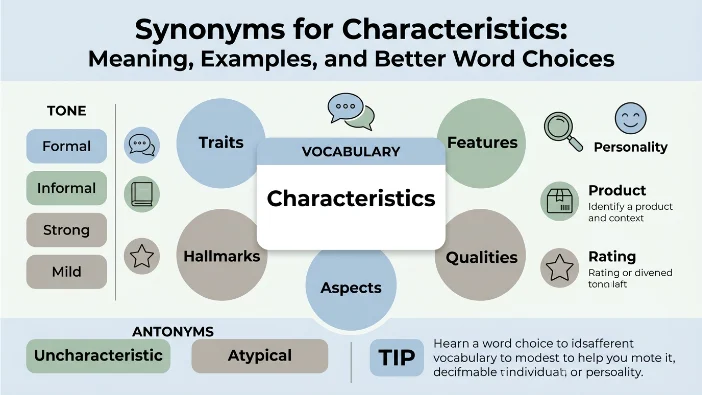
The best synonyms for characteristics are traits, features, attributes, qualities, aspects, properties, and hallmarks. Choose traits for personality or behavior, features for prominent or noticeable qualities, attributes for inherent or assigned properties, and qualities for essential nature or worth. The right choice depends on tone, context, and intensity.
What Does Characteristics Mean?
Characteristics are the features, qualities, or traits that define someone or something. They represent what makes a person, object, or group recognizable or distinct.
Part of Speech: Noun (typically plural)
Simple Definition: The distinguishing qualities or attributes of a person, thing, or group.
Core Idea: The word comes from the Greek kharaktēr, meaning “a mark or imprint on the soul” . Just as a mark identifies ownership, characteristics identify what something truly is.
Example Sentences:
- Patience is one of her best characteristics.
- The characteristics of a healthy ecosystem include biodiversity, clean water, and stable food chains.
Core Meaning of Characteristics
Characteristics are the identifiable marks of identity.
- They can be physical, like a bird’s feather color or a person’s height.
- They can be behavioral, like a child’s curiosity or a leader’s decisiveness.
- They can also be abstract, like the atmosphere of a city or the functionality of a product.
When you describe characteristics, you answer the question: “What is this like?” or “What defines this?” For example, the characteristics of a smartphone include its screen size, processing speed, and camera quality. The characteristics of a good friend include loyalty, honesty, and reliability.
The word works across many fields.
- In psychology, characteristics refer to personality traits.
- In biology, they mean physical or genetic properties.
- In product development, they mean features or specifications.
Grammar and Usage Notes
Part of Speech: Noun (countable)
Common Sentence Patterns:
- “The characteristics of [subject] include [list].”
- “One characteristic of [subject] is [quality].”
- “[Subject] has several characteristics.”
- “[Quality] is a characteristic of [subject].”
Common Collocations:
- Defining characteristics
- Physical characteristics
- Personal characteristics
- Unique characteristics
- Common characteristics
- Characteristics of [something]
- Set of characteristics
- Observable characteristics
When It Sounds Natural:
Characteristics works well in formal writing, academic contexts, professional reports, and descriptive passages. It sounds natural when you need a neutral, precise word for identifying qualities.
When a Synonym May Work Better:
- Use traits for personality or genetic qualities.
- Use features for noticeable or prominent parts.
- Use attributes for inherent or assigned properties.
- Use qualities when discussing value or excellence .
- Use aspects when discussing parts of a larger whole.
Best Synonyms for Characteristics
| Synonym | Meaning | Tone | Best Use Case | Example Sentence |
|---|---|---|---|---|
| Traits | Distinguishing features of personal nature | Neutral to formal | Personality, behavior, genetics | Honesty is one of her best traits. |
| Features | Prominent or noticeable attributes | Neutral | Physical aspects, products, design | The phone’s best features include the camera and battery life. |
| Attributes | Inherent qualities or properties | Formal to neutral | Professional or academic contexts | Curiosity is an important attribute for a scientist. |
| Qualities | Essential or distinguishing attributes | Neutral | Character, worth, performance | She has many admirable qualities. |
| Aspects | Distinct parts or elements of a whole | Neutral to formal | Complex subjects with multiple parts | The project has several challenging aspects. |
| Properties | Inherent qualities of a substance or object | Technical | Science, technology, materials | The chemical properties of the compound are well understood. |
| Hallmarks | Distinctive or identifying features | Formal | Professional writing, achievements | Attention to detail is the hallmark of her work. |
Common Synonyms for Characteristics
These everyday synonyms work in most writing and conversation.
Traits
Meaning: Specific qualities or features that define a person or thing, especially personality or genetic qualities.
Best Context: Describing personality, behavior, or hereditary features.
Example: Her calm demeanor is one of her most admirable traits.
Features
Meaning: Prominent or noticeable attributes or parts.
Best Context: Describing physical appearance, products, or design.
Example: The new car has several safety features.
Attributes
Meaning: Inherent qualities or properties assigned to someone or something.
Best Context: Professional or academic writing about abilities, skills, or qualities.
Example: His technical expertise is a valuable attribute.
Qualities
Meaning: Essential or distinguishing characteristics, often related to worth or value.
Best Context: Describing character, performance, or excellence.
Example: The candidate has all the qualities we need.
Aspects
Meaning: Distinct parts or facets of a larger whole.
Best Context: Breaking down complex subjects into manageable parts.
Example: We need to consider all aspects of the problem.
Properties
Meaning: Inherent qualities of a substance or material.
Best Context: Scientific, technical, or material descriptions.
Example: The chemical properties of water are well documented.
Formal Synonyms for Characteristics
Use these alternatives in academic writing, business reports, professional communication, and essays.
Hallmarks
Meaning: Distinctive features that indicate excellence or authenticity.
Best Context: Professional writing, achievements, standards.
Example: Innovation is a hallmark of great companies.
Idiosyncrasies
Meaning: Distinctive or peculiar individual traits.
Best Context: Psychological or behavioral descriptions, literary writing.
Example: His idiosyncrasies make him a memorable character.
Peculiarities
Meaning: Unusual or distinctive characteristics.
Best Context: Descriptive or analytical writing.
Example: The author’s peculiarities give her writing a distinctive voice.
Discriminants
Meaning: Features that distinguish one thing from another.
Best Context: Technical, analytical, or classification writing.
Example: The researchers identified several discriminants between the two species.
Informal Synonyms for Characteristics
Use these casual alternatives in conversation, social media, friendly writing, and personal messages.
Qualities (colloquial usage)
Meaning: Good or positive characteristics.
Best Context: Compliments, casual conversations.
Example: She’s got great qualities as a leader.
Traits (in everyday speech)
Meaning: Personal characteristics, often genetic or behavioral.
Best Context: Casual discussions about people.
Example: Stubbornness runs in the family it’s a trait we all share.
Markers
Meaning: Identifying signs or indicators.
Best Context: Informal observations.
Example: Green shoots are markers of spring in the garden.
Things (about someone)
Meaning: General reference to characteristics.
Best Context: Very casual conversation.
Example: There are a few things about him I really like.
Strong Synonyms for Characteristics
These words carry more emphasis or specificity and often imply significance or distinctiveness.
Hallmarks
Emphasis: Implies a definitive, distinguishing feature that sets something apart.
Use When: You want to emphasize excellence or clear differentiation.
Example: Integrity is the hallmark of a trusted leader.
Distinctives
Emphasis: Implies unique qualities that make something stand out.
Use When: You want to highlight what makes something different.
Example: The restaurant’s distinctives include its farm-to-table approach.
Emblems
Emphasis: Implies symbolic or representative qualities.
Use When: The characteristic represents or symbolizes something larger.
Example: Courage is an emblem of true heroism.
Outlines
Emphasis: Implies defining or shaping characteristics.
Use When: Discussing the structure or essential form of something.
Example: The outlines of her character emerged over time.
Mild Synonyms for Characteristics
These softer alternatives work when you don’t need strong emphasis or when you want more general or neutral language.
Aspects
Tone: Neutral, gentle, part-to-whole.
Use When: Discussing parts of a larger subject without strong judgment.
Example: Several aspects of the plan need review.
Elements
Tone: Neutral, factual, component-focused.
Use When: Describing parts that combine to make a whole.
Example: The elements of a good design are color, layout, and typography.
Facets
Tone: Neutral, descriptive, balanced.
Use When: Discussing multiple angles or dimensions.
Example: There are many facets to this problem.
Synonyms for Characteristics by Context
Everyday Conversation
In casual speech, simple words work best. Use traits for personality, features for products or appearance, and qualities for general praise.
Good choices: traits, features, qualities, things
Example: What qualities do you look for in a friend?
Professional Writing
In business or workplace writing, use precise, neutral words that convey professionalism. Attributes suggests inherent value, hallmarks suggests excellence, and properties suggests technical accuracy .
Good choices: attributes, hallmarks, properties, characteristics, aspects
Example: Leadership attributes include communication and decision-making skills.
Academic Writing
Academic writing requires clarity and precision. Use parameters for measurable qualities, discriminants for distinguishing features, and variables for changeable qualities .
Good choices: parameters, discriminants, variables, attributes, properties
Example: The study measured several psychological variables.
Creative Writing
Creative writing thrives on variety and specificity. Use idiosyncrasies for quirky traits, mannerisms for physical behaviors, and peculiarities for unusual qualities .
Good choices: idiosyncrasies, mannerisms, peculiarities, hallmarks, traits
Example: His mannerisms the way he tilted his head gave him away.
Marketing Copy
Marketing emphasizes benefits and appeal. Use features for product attributes, aspects for experience elements, and hallmarks for brand reputation.
Good choices: features, aspects, hallmarks, qualities, attributes
Example: The hallmarks of our service are reliability and speed.
Emotional Expression
When describing people’s emotional or personality traits, traits, qualities, and aspects work well.
Good choices: traits, qualities, characteristics, aspects
Example: Her kind qualities make her a great colleague.
Another Word for Characteristics in a Sentence
Here are realistic example sentences using different synonyms for characteristics.
- Traits: Stubbornness is a trait she inherited from her father.
- Features: The building’s most striking features are its tall windows.
- Attributes: His problem-solving skills are key attributes for the role.
- Qualities: The team’s winning qualities include confidence and focus.
- Aspects: Many aspects of the plan are working well.
- Properties: The physical properties of steel make it ideal for construction.
- Hallmarks: The hallmarks of a quality product are durability and design.
- Idiosyncrasies: Her writing is full of charming idiosyncrasies.
- Peculiarities: Local peculiarities reflect the region’s history.
- Mannerisms: His mannerisms made him instantly recognizable.
- Discriminants: The scientists found discriminants between the two fossils.
- Parameters: We defined the parameters for success early on.
- Variables: Several variables affect the experiment’s outcome.
- Attributes (plural): What attributes do you value most in a leader?
- Traits (plural): The study examined personality traits in different cultures.
Characteristics Synonyms Compared
These words are often used interchangeably, but they have distinct shades of meaning.
| Word | Core Meaning | Tone | Best For |
|---|---|---|---|
| Trait | A distinguishing feature of personal nature | Neutral | Personality, genetics |
| Feature | A prominent or noticeable part | Neutral | Appearance, products |
| Attribute | An inherent quality or property | Formal | Professional contexts |
| Quality | An essential or distinguishing attribute | Neutral | Character, worth |
| Aspect | A part or facet of a larger whole | Neutral | Complex analysis |
| Property | An inherent quality of a substance | Technical | Science, materials |
| Hallmark | A distinctive feature indicating quality | Formal | Achievements, standards |
Example Comparison:
- “Traits” describes what she is like (personality).
- “Features” describes what she looks like (appearance).
- “Attributes” describes her capabilities (skills).
- “Qualities” describes her goodness (character).
Words Similar to Characteristics
These words are related to characteristics but are not always exact synonyms. They belong to the same semantic field but have different nuances.
Mannerisms
Why It’s Related: Mannerisms describe specific behaviors or habits, especially physical ones.
Why It May Not Replace Characteristics: It’s narrower, focusing only on observable behavior.
When It’s Useful: When describing people’s physical habits or gestures.
Discriminants
Why It’s Related: Discriminants are characteristics used to tell things apart.
Why It May Not Replace Characteristics: It emphasizes differentiation rather than description.
When It’s Useful: In analytical contexts where comparison is key.
Parameters
Why It’s Related: Parameters are measurable characteristics or boundaries.
Why It May Not Replace Characteristics: It suggests limits or measures, not qualities.
When It’s Useful: In scientific, technical, or project contexts.
Variables
Why It’s Related: Variables are changeable characteristics.
Why It May Not Replace Characteristics: It emphasizes changeability and measurement.
When It’s Useful: In research, statistics, or scientific contexts.
Elements
Why It’s Related: Elements are basic components of a whole.
Why It May Not Replace Characteristics: It focuses on parts, not qualities.
When It’s Useful: When describing the makeup of something.
Antonyms of Characteristics
Understanding opposites helps clarify meaning.
| Antonym | Short Meaning | Example Sentence |
|---|---|---|
| Uncharacteristic | Not typical or distinctive | Her outburst was uncharacteristic of her calm nature. |
| Atypical | Not representative of a group | His approach was atypical for the team. |
| Nondescript | Lacking distinctive features | The building was nondescript and unmemorable. |
| Ordinary | Common, not special | It’s an ordinary house with no remarkable features. |
| Generic | Lacking specific or distinctive qualities | The packaging was generic and uninspiring. |
How to Choose the Right Synonym for Characteristics
Follow these guidelines to pick the best word.
1. Match the Context
- Formal writing: attributes, hallmarks, properties
- Informal writing: traits, features, qualities
- Technical writing: properties, parameters, variables
- Creative writing: idiosyncrasies, mannerisms, peculiarities
2. Match the Tone
- Neutral tone: characteristics, aspects, features
- Positive tone: qualities, attributes, hallmarks
- Descriptive tone: traits, mannerisms, peculiarities
3. Check the Intensity
- Strong: hallmarks, distinctives, emblems
- Mild: aspects, facets, elements
- Neutral: features, traits, attributes
4. Think About the Reader
- General readers: traits, features, qualities
- Professionals: attributes, hallmarks
- Specialists: properties, discriminants
5. Check Whether the Synonym Is Exact
- A trait is usually personal or genetic.
- A feature is often physical or product-related.
- An attribute is often capability-related.
- A quality often implies goodness or worth.
6. Keep the Sentence Natural
- Read your sentence out loud.
- Does the synonym fit smoothly?
- Does it say what you mean?
7. Use Simple Words When Clarity Matters
- If your reader might not know a word, choose a simpler synonym.
- “Traits” is clearer than “idiosyncrasies” for general audiences.
Common Mistakes When Using Synonyms for Characteristics
Avoid these errors to keep your writing clear and accurate.
1. Choosing a Word with the Wrong Tone
Using “attributes” in casual conversation sounds stiff. Using “traits” in a formal report may sound too simple.
Solution: Match the word to the situation. Formal contexts need formal words. Casual contexts need casual words.
2. Using a Synonym That Is Too Strong
“Hallmark” implies excellence or significant distinction. Using it for minor qualities sounds exaggerated.
Solution: Use “hallmarks” only for defining or exceptional features.
3. Using a Formal Word in Casual Writing
“Discriminants” sounds out of place in an email to a friend.
Solution: “Features” or “traits” work better for everyday writing.
4. Using a Casual Word in Professional Writing
“Things about someone” is too vague for a performance review.
Solution: “Attributes,” “qualities,” or “characteristics” are more precise.
5. Replacing Characteristics Without Checking Meaning
“Elements” suggests components, not qualities. Using it when you mean “traits” changes the meaning.
Solution: Check the definition before substituting.
6. Treating Related Words as Exact Synonyms
“Properties” works for materials but sounds odd for personality.
Solution: Use context-appropriate words.
7. Making the Sentence Sound Unnatural
“His hallmark attributes” might sound like corporate jargon.
Solution: Use one synonym at a time: “His hallmark is attention to detail.
Quick Synonym List for Characteristics
Common Synonyms
- Traits
- Features
- Qualities
- Aspects
- Attributes
Formal Synonyms
- Hallmarks
- Idiosyncrasies
- Peculiarities
- Discriminants
Informal Synonyms
- Traits (casual)
- Qualities (casual)
- Markers
- Things (about someone)
Strong Synonyms
- Hallmarks
- Distinctives
- Emblems
- Outlines
Mild Synonyms
- Aspects
- Facets
- Elements
Related Words
- Mannerisms
- Discriminants
- Parameters
- Variables
- Elements
FAQs
What is the best synonym for characteristics?
The best synonym for characteristics depends on context. For personality, use “traits.
- For physical or product qualities, use “features.”
- For professional or academic contexts, use “attributes” or “hallmarks.”
- For general use, “qualities” and “aspects” work well .
What is another word for characteristics in a person?
Traits and qualities are the most common alternatives for describing a person’s characteristics. “Traits” often refers to personality features, while “qualities” suggests positive or valuable attributes . “Mannerisms” describes physical habits.
What is a formal synonym for characteristics?
“Attributes,” “hallmarks,” and “properties” are formal synonyms. Use “attributes” for inherent qualities, “hallmarks” for distinguishing features of excellence, and “properties” for technical or scientific contexts .
What is an informal synonym for characteristics?
“Traits” and “qualities” work in informal contexts. In very casual conversation, you might also say “the things about someone” or “markers” .
What is a stronger word for characteristics?
“Hallmarks,” “distinctives,” and “emblems” are stronger synonyms. These words carry more emphasis and suggest significant, distinguishing features .
What is a milder word for characteristics?
“Aspects,” “facets,” and “elements” are milder synonyms. They suggest parts of a whole without emphasizing importance or distinction .
What words are similar to characteristics?
Words similar to characteristics include mannerisms, discriminants, parameters, variables, and elements. However, these words are often narrower or more technical than “characteristics.” Use them only when they precisely fit your context .
What is the opposite of characteristics?
The opposite of characteristics includes “uncharacteristic,” “atypical,” “nondescript,” “ordinary,” and “generic.” These words describe things that lack distinctive qualities .
How do I choose the right synonym for characteristics?
Choose the right synonym by matching context, tone, and intensity. Consider whether you’re writing formally or informally, whether the feature is physical or personality-based, and whether you need a strong or mild word. Read your sentence aloud to check if it sounds natural.
Conclusion
Characteristics describe what makes people and things unique. The best synonym for characteristics depends on your context, tone, and what you want to emphasize.
- Use traits for personality and behavior.
- Use features for physical and product qualities.
- Use attributes for professional and academic contexts.
- Use qualities for character and worth.
- Use aspects for parts of a larger whole.
Understanding these differences helps you write more clearly and precisely. Next time you describe what makes something distinct, you’ll choose the right word with confidence.
Read More Related Articles:
- Synonyms for Embarrassed | Smarter Word Choices for Every Context In 2026
- Synonyms For Felt | Make Your Writing More Descriptive In 2026
- Synonyms for Stress | Meaning, Examples, and Better Word Choices In 2026

Grace Phillips contributes content to SynonymsAura.com, where she writes about language, vocabulary and everyday communication. Her work is centered on helping readers find the right words and express themselves with greater clarity and confidence.