Time is a tricky thing to describe, and “eventually” is one of those words we reach for all the time. But sometimes it doesn’t feel quite right. Maybe it’s too vague, too formal, or not strong enough for what you’re trying to say.
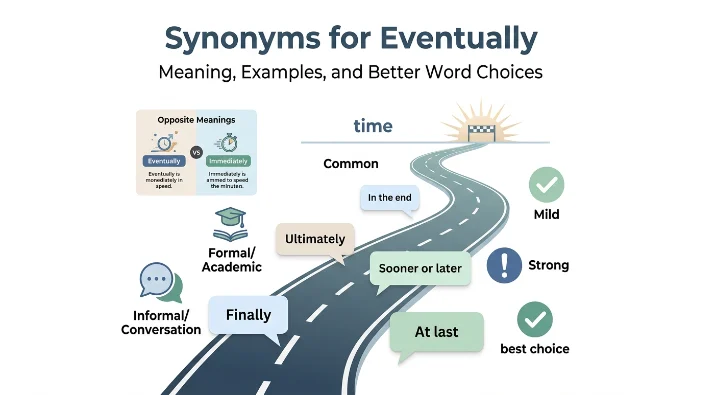
The best synonyms for eventually are finally, ultimately, in the end, and sooner or later. The right choice depends on tone, context, and intensity. For example, “finally” emphasizes a long wait or a sequence end, while “ultimately” focuses on a final outcome after a process. “Sooner or later” is more casual, and “in the end” is neutral and widely usable.
This guide explains the meaning of “eventually,” compares its best synonyms, and helps you pick the perfect word for any situation.
Best Synonyms for Eventually
The best synonyms for eventually are finally, ultimately, in the end, and sooner or later. Use finally when emphasizing a long wait or the last step in a sequence. Use ultimately for final outcomes after a process. Use in the end for neutral, everyday use. Use sooner or later for casual predictions about the future .
What Does Eventually Mean?
Eventually is an adverb that means “at an unspecified time in the future” or “in the end, after a delay or process.” It’s the word you use when something happens, but not right away. It suggests that a result or event will come, though maybe later than expected or after some time has passed .
Core idea: Something that will happen, but not immediately.
Part of speech: Adverb
Common usage: To describe outcomes, predictions, or events that occur after a delay.
Example sentences:
- “I know it’s tough now, but things will get better eventually.”
- “The package was lost for weeks, but it eventually arrived.”
Core Meaning of Eventually
The word “eventually” carries the sense of an endpoint reached after a period of time. It’s not about speed or urgency it’s about certainty. When you say something will happen “eventually,” you’re telling your reader or listener that it’s coming. You just can’t say exactly when .
Think of it this way: “Eventually” sits between “soon” and “never.” It promises a result while acknowledging that patience is required. It’s a hopeful word in many cases, because it suggests a positive outcome will arrive. But it can also be neutral or even a little weary, like when you say, “We’ll clean the garage eventually,” and you both know it might take a while.
Grammar and Usage Notes
Part of speech: Adverb
Common sentence patterns:
- At the beginning: “Eventually, we found the restaurant.”
- Between subject and verb: “She eventually agreed to the deal.”
- At the end: “We’ll figure it out eventually.”
Common collocations (words often paired with it):
- eventually + happen, arrive, find, learn, realize, become, succeed, die, get, reach, understand, appear, return, accept, settle
- “He eventually became the manager.”
- “They eventually realized their mistake.”
When “eventually” sounds natural:
- Describing future outcomes with certainty but without a specific timeline.
- Talking about processes that take time (learning a skill, healing, recovering).
- Making predictions about future events.
- Summarizing the end of a long story or series of events.
When a synonym may work better:
- If you want to emphasize the end of a sequence of steps, “finally” is often better .
- If you want to emphasize the final outcome or underlying cause, “ultimately” is stronger .
- If you want a more formal or emphatic tone, choose “in the final analysis” or “at the end of the day.”
- If you want a casual, conversational tone, “sooner or later” or “one day” work well .
Best Synonyms for Eventually
Common Synonyms for Eventually
These are the everyday synonyms you’ll hear in conversation and see in most writing. They’re reliable, widely understood, and fit most situations.
Finally
Meaning: After a long time or as the final step in a series.
Best context: Use “finally” when you want to emphasize how long you’ve waited or that this is the last thing to happen. It adds a sense of relief or closure .
Example: “After three hours of traffic, we finally got home.”
Ultimately
Meaning: In the end, after everything has been considered; the final outcome.
Best context: Use “ultimately” when you’re talking about the most important result, cause, or conclusion after a process or chain of events .
Example: “Ultimately, the success of the project depends on good communication.”
In the End
Meaning: After everything happens or is taken into account.
Best context: This is the most neutral, all-purpose synonym. It works in almost any context where you want to say “eventually.” It doesn’t emphasize the wait as strongly as “finally” .
Example: “We had our ups and downs, but in the end, we were grateful for the experience.”
Sooner or Later
Meaning: At some point in the future, inevitably.
Best context: This is the casual, conversational choice. It’s great for making predictions or stating inevitable outcomes. It has a slightly informal, “everyone knows this” feel .
Example: “If you keep putting it off, you’ll have to deal with it sooner or later.”
One Day
Meaning: At some unspecified time in the future.
Best context: Use “one day” when you’re talking about hopes, dreams, or things you expect to happen but don’t know when. It sounds optimistic and open-ended .
Example: “One day, I’ll write that novel I’ve been thinking about.”
In Time
Meaning: Eventually, after enough time passes; or early enough.
Best context: “In time” suggests that with enough patience or the right amount of time, something will happen. It can also mean “not late” .
Example: “Don’t worry about her choices she’ll learn in time.”
Formal Synonyms for Eventually
When you’re writing an academic paper, a business report, or a professional email, these formal synonyms add polish and precision.
Ultimately
As mentioned above, “ultimately” is a strong, formal choice that works well when analyzing causes, outcomes, or final decisions. It sounds considered and analytical .
Example: “Ultimately, the data suggests that consumer behavior has shifted permanently.”
In the Final Analysis
Meaning: After examining everything; when you look at all the facts.
Best context: Use this in formal reports or academic writing to introduce a final conclusion after presenting evidence .
Example: “In the final analysis, the policy’s benefits outweigh its costs.”
In the Course of Time
Meaning: As time goes on; after a period.
Best context: This is a more formal, slightly old-fashioned way to say “eventually.” It works in essays or historical analysis.
Example: “In the course of time, the empire’s influence began to decline.”
At Length
Meaning: After a long time; finally.
Best context: Formal writing that needs to emphasize a long delay or process. It has a slightly literary feel .
Example: “After much discussion, they agreed at length on a compromise.”
In the Fullness of Time
Meaning: When the right time comes; eventually.
Best context: This is a formal, almost poetic phrase often used in literary or philosophical writing. It suggests things happen when they are meant to .
Example: “In the fullness of time, the truth would emerge.”
Informal Synonyms for Eventually
For conversations, emails to friends, social media posts, or casual blog writing, these alternatives sound more natural and relaxed.
Sooner or Later
As mentioned, this is the go-to informal choice. It’s conversational and makes a prediction sound like common sense .
Example: “I keep telling her, she’ll have to do it sooner or later.”
One of These Days
Meaning: At some point in the future, but probably not soon.
Best context: This is a very casual, friendly phrase. It often implies a vague intention that may or may not happen soon.
Example: “One of these days, we should actually go to that new restaurant.”
At the End of the Day
Meaning: When everything is considered; in the end.
Best context: This is a common, slightly informal idiom for summing up a situation. It’s used in everyday speech and business meetings alike .
Example: “We can make all the plans we want, but at the end of the day, we just need to start.”
Sometime
Meaning: At an unspecified or unknown time.
Best context: This is the most casual and vague option. It works when you’re not being specific about when something will happen .
Example: “We should catch up sometime.”
Down the Road
Meaning: In the future; later.
Best context: Very casual and American English-friendly. It suggests something will happen later, not now.
Example: “We can think about expanding down the road.”
Strong Synonyms for Eventually
Some synonyms carry more emotional weight or emphasis. Use these when you want to stress the outcome, the wait, or the importance of what’s coming.
At Last
Meaning: After a very long and often difficult wait.
Why it’s strong: “At last” carries relief and finality. It’s what you say when you’ve been waiting and waiting, and it’s finally over. It’s more emotional than “finally” .
When to use: Use it when you want to convey relief, joy, or the end of a difficult period.
Example: “At last, we had an answer after months of uncertainty.”
Finally (when emphasizing a long wait)
Meaning: After a long delay or difficulty.
Why it’s strong: “Finally” is one of the stronger synonyms for “eventually” because it focuses on the wait. It can also signal that something is the last in a series of steps .
When to use: Use it to end a story, finish a list, or describe the end of a long delay.
Example: “She finally got the promotion she deserved.”
Once and for All
Meaning: Finally and decisively; in a way that ends uncertainty.
Why it’s strong: This phrase emphasizes finality and decisiveness. It’s about ending something permanently, not just eventually arriving at a result .
When to use: Use it when you want to stress that a decision or action is definitive and there’s no going back.
Example: “We need to settle this issue once and for all.”
In the End (when summarizing a difficult journey)
Meaning: After all the events or experiences.
Why it’s strong: “In the end” can carry emotional weight when it’s used to conclude a story full of challenges or a long reflection. It becomes stronger when the journey was notable .
When to use: Use it for a summary or conclusion that feels earned.
Example: “In the end, all their hard work paid off.”
Mild Synonyms for Eventually
Sometimes you don’t want to emphasize the wait or the finality. You just want to gently say something will happen.
Sometime
Meaning: At an unspecified time.
Why it’s mild: “Sometime” is vague and gentle. It doesn’t carry the weight of “finally” or “ultimately.” It just says “at some point” without pressure .
When to use: Use it when you’re making a soft suggestion or prediction.
Example: “We should get together sometime next week.”
In Time
Meaning: Eventually; given enough time.
Why it’s mild: “In time” feels patient and natural. It suggests that things will work out, but it doesn’t dwell on the wait .
When to use: Use it for healing, learning, or growth things that take time but aren’t urgent.
Example: “She’ll come around in time.”
One Day
Meaning: At some point in the future.
Why it’s mild: “One day” is hopeful and open. It feels less urgent or specific than “eventually” .
When to use: Use it for dreams or long-term hopes.
Example: “I’ll get there one day.”
By and By
Meaning: After a while; eventually.
Why it’s mild: This phrase has a gentle, old-fashioned, almost literary quality. It doesn’t rush anything .
When to use: Use it in poetry, songwriting, or storytelling.
Example: “The storm passed, and by and by, the sun appeared.”
Synonyms for Eventually by Context
Everyday Conversation
In daily chat, you want words that are easy, natural, and don’t sound stiff. Reach for sooner or later, one of these days, sometime, or down the road. These phrases keep the tone light and relatable.
Example: “Don’t worry, we’ll get to the movies sooner or later.”
Professional Writing
For business, marketing, and professional contexts, clarity and polish matter. Use ultimately, in the long run, or in the end. These alternatives sound considered and professional without being overly casual or vague.
Example: “Ultimately, this strategy will increase our market share.”
Academic Writing
In essays, research papers, and formal analyses, precision is key. Use ultimately, in the final analysis, in the course of time, or in the fullness of time. These phrases suggest careful reasoning and a comprehensive view.
Example: “In the final analysis, the evidence supports the hypothesis.”
Creative Writing
In storytelling, poetry, or descriptive writing, you want words that fit the mood and rhythm. Try by and by for a gentle, old-fashioned feel, at last for dramatic emphasis, or one day for a hopeful future.
Example: “She wandered through the forest, and by and by, the cottage appeared.”
Emotional Expression
When you’re talking about feelings, relief, or important personal milestones, choose words that carry emotional weight. At last, finally, or once and for all add impact.
Example: “He had waited for this moment his whole life, and at last, it had arrived.”
Another Word for Eventually in a Sentence
Here are 12–15 natural example sentences using different synonyms for “eventually.
- Finally, the rain stopped, and we could go outside.
- She worked hard for years and ultimately achieved her goal .
- We can argue about it all night, but in the end, we’ll have to compromise .
- If you don’t start studying, you’ll fail sooner or later .
- He will understand in time that you were only trying to help .
- I dream of visiting Paris one day .
- At last, the jury reached a verdict after days of deliberation .
- Investing in your health pays off in the long run .
- At the end of the day, what matters most is your family .
- He kept practicing, and eventually he became a professional musician .
- We knew we’d have to face the problem down the road.
- She struggled with the decision but ultimately chose the path that felt right.
- The lost treasure was found by and by in a forgotten cave .
- In the fullness of time, the truth about the matter was revealed .
Eventually Synonyms Compared
“Finally,” “ultimately,” and “in the end” are close cousins, but they each have a unique flavor.
Finally vs. Ultimately
Both can mean “eventually,” but they focus on different things. Finally is about the wait and the conclusion of a sequence. It’s the word for when you’ve been waiting or when you’re listing the last step . Ultimately is about the final outcome or the underlying cause. It’s the word for when you’re analyzing what matters most or how things turned out in the grand scheme of things .
Compare:
- “He finally arrived” = He arrived after a long wait.
- “He ultimately arrived” = He arrived in the end, after other things happened.
In the End vs. At the End of the Day
In the end is neutral and works in all situations . At the end of the day is more informal and idiomatic, often used when making a judgment after considering everything . Both mean “after everything is considered,” but “at the end of the day” is more casual.
Sooner or Later vs. One Day
Sooner or later suggests inevitability something will happen because it’s bound to . One day is more open and hopeful it expresses a wish or a possibility . “Sooner or later, you’ll have to pay taxes” sounds certain. “One day, I’ll visit the moon” sounds like a dream.
Words Similar to Eventually
These words belong to the same “time and outcome” family but aren’t always exact synonyms.
- Subsequently: Means “afterward” or “then.” It describes a sequence, not necessarily an outcome after a long time. “He quit his job and subsequently moved to Australia.”
- Consequently: Means “as a result.” It describes cause and effect, not time. “She didn’t study, and consequently she failed.”
- Afterward: Means “at a later time.” It’s general and doesn’t imply a long wait. “We ate dinner, and afterward we went for a walk.”
- Henceforth: Means “from this time onward.” It’s about the future from now, not a final outcome. “The new rules will apply henceforth.”
- Thereafter: Means “after that time.” It’s about a sequence, not a final outcome. “He graduated and thereafter worked as a teacher.”
These words are related to “eventually” because they all deal with time and sequence. But they don’t share the “end result after a while” meaning that “eventually” and its true synonyms have. Use them when you need to talk about time without emphasizing a delayed final result.
Antonyms of Eventually
The opposite of “eventually” is a word that means “now” or “immediately,” with no delay. Here are the main antonyms .
- Immediately: Right away; without delay. “She answered immediately.”
- Instantly: Very quickly and without any pause. “He recognized her instantly.”
- Suddenly: Happening unexpectedly and quickly. “The power went out suddenly.”
- Early: Before the expected time. “The package arrived early.”
- Now: At this moment. “I need you to do it now.”
- Without delay: Immediately. “We will respond without delay.”
Example comparing synonym and antonym:
- With eventually: “The flowers will bloom eventually.” (after some time)
- With antonym: “The flowers bloomed immediately.” (right away)
How to Choose the Right Synonym for Eventually
Picking the right word is simple if you consider a few key factors.
1. Match the context. Are you writing a business report? Choose “ultimately” or “in the final analysis.” A casual text to a friend? Use “sooner or later” or “down the road.”
2. Match the tone. Do you want to sound formal, casual, emotional, or neutral? Choose your synonym accordingly. “At last” is emotional. “In the end” is neutral.
3. Check the intensity. Do you want to emphasize the long wait? Use “finally” or “at last.” Do you want to emphasize the final outcome? Use “ultimately.” Do you want to keep it light and vague? Use “sometime” or “one day.”
4. Think about the reader. What will your audience expect? Academic readers want precision. Casual readers want warmth.
5. Check if the synonym is exact or just related. Don’t use “subsequently” for “eventually” unless you’re talking about a sequence of events, not a delayed outcome.
6. Keep the sentence natural. If the word sounds forced or out of place, pick a simpler option. “In the end” is almost always natural.
7. Use simple words when clarity matters. If you’re just trying to say “at some point in the future,” don’t overthink it. “Eventually,” “in the end,” or “sooner or later” are safe bets.
Common Mistakes When Using Synonyms for Eventually
It’s easy to pick the wrong word. Here are the most common mistakes to avoid.
- Using “finally” when you don’t mean a long wait. If you’re just predicting a future event without wanting to emphasize the delay, “finally” might sound too dramatic. Use “in the end” or “ultimately.”
- Using “ultimately” too casually. “Ultimately” sounds weighty. Don’t use it in light conversation about everyday plans. “Sooner or later” is better there.
- Using “sometime” when you mean “eventually.” “Sometime” is very vague. If you want to express certainty that something will happen, use “eventually” or “sooner or later.”
- Using formal synonyms in casual writing. If you write “in the fullness of time” in a text message, you’ll sound overly formal. Keep it simple: “one day” or “eventually.”
- Using casual synonyms in professional writing. “At the end of the day” is common, but it may be too informal for an academic paper or a legal document.
- Treating related words as exact synonyms. Words like “subsequently” and “consequently” are not direct replacements. They have different meanings.
- Making the sentence sound unnatural. If the synonym you chose feels forced, replace it with a simpler, more natural word.
Quick Synonym List for Eventually
Common Synonyms
- Finally
- Ultimately
- In the end
- Sooner or later
- One day
- In time
Formal Synonyms
- Ultimately
- In the final analysis
- In the course of time
- At length
- In the fullness of time
Informal Synonyms
- Sooner or later
- One of these days
- At the end of the day
- Sometime
- Down the road
Strong Synonyms
- At last
- Finally
- Once and for all
- In the end
Mild Synonyms
- Sometime
- In time
- One day
- By and by
Related Words
- Subsequently
- Consequently
- Afterward
- Henceforth
- Thereafter
FAQs
What is the best synonym for eventually?
The best synonym depends on the context. For a long wait, use “finally.” For the final outcome, use “ultimately.” For general use, use “in the end.” For casual predictions, use “sooner or later” .
What is another word for eventually?
Another word for “eventually” is “finally,” “ultimately,” “in the end,” or “sooner or later.” Choose based on tone and context. “Finally” emphasizes a wait, “ultimately” emphasizes an outcome, and “in the end” is neutral .
What is a formal synonym for eventually?
Formal synonyms for “eventually” include “ultimately,” “in the final analysis,” “in the course of time,” and “in the fullness of time.” These are suitable for academic or professional writing .
What is an informal synonym for eventually?
Informal synonyms for “eventually” include “sooner or later,” “one of these days,” “at the end of the day,” “sometime,” and “down the road.” These work well in conversation and casual writing .
What is a stronger word for eventually?
A stronger word for “eventually” is “at last,” “finally,” or “once and for all.” These emphasize relief, a long wait, or decisiveness .
What is a milder word for eventually?
A milder word for “eventually” is “sometime,” “in time,” “one day,” or “by and by.” These are gentler, less urgent, and more vague .
What words are similar to eventually?
Words similar to “eventually” but not exact synonyms include “subsequently,” “consequently,” “afterward,” “henceforth,” and “thereafter.” They relate to time and sequence but don’t mean “after a delay” .
What is the opposite of eventually?
The opposite of “eventually” is “immediately,” “instantly,” “suddenly,” “early,” or “now.” These words mean “right away” with no delay .
How do I choose the right synonym for eventually?
To choose the right synonym, consider the context, tone, and intensity. Match the word to your audience and what you want to emphasize the wait, the outcome, or the inevitability. Keep the sentence natural and clear.
Conclusion
Eventually” is a versatile word, but sometimes you need a different shade of meaning or tone. Whether you choose the strength of “at last,” the formality of “ultimately,” the neutrality of “in the end,” or the casual ease of “sooner or later,” the right word is the one that fits your sentence and your reader.
The best synonym depends on what you want to say. If you want to emphasize the wait, pick “finally.” If you want to focus on the final outcome, pick “ultimately.” If you want something simple and natural, go with “in the end.” And if you’re just having a conversation, “sooner or later” works perfectly.
Now you have the tools to choose the best alternative for any writing situation. The right word is always the one that sounds natural, fits the tone, and says exactly what you mean.
Read More Related Articles:
- Synonyms for Nuanced | Powerful Word Choices for Creative Writing In 2026
- Synonyms for Vivid | Create Stronger Mental Images in Writing In 2026
- Synonyms for Compassionate | Upgrade Your Writing with Deeper Emotion In 2026

Grace Phillips contributes content to SynonymsAura.com, where she writes about language, vocabulary and everyday communication. Her work is centered on helping readers find the right words and express themselves with greater clarity and confidence.