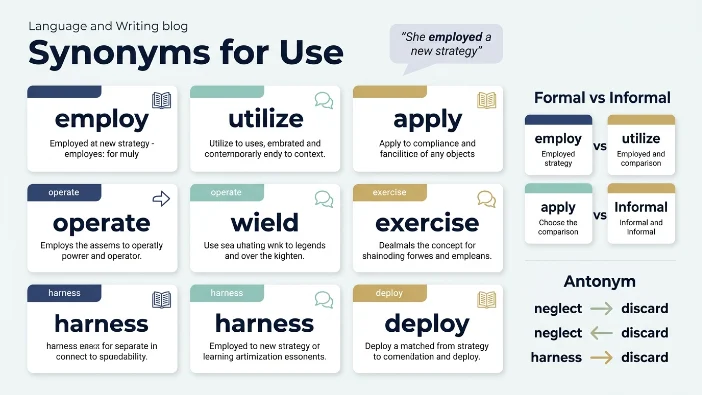
The best synonyms for “use” depend on what you’re trying to say. If you’re looking for synonyms for use, you have plenty of options. Common alternatives include employ, utilize, apply, and operate. But the right choice depends entirely on your meaning, tone, and context.
Sometimes you need a formal word for a business report. Other times you need a casual word for a text message. You might need a strong word to emphasize importance or a mild word to soften your meaning. This guide covers all of them.
Best Synonyms for Use
The best synonyms for use are employ, utilize, apply, operate, wield, and exercise. The right choice depends on your tone, context, and what exactly you’re trying to say. For formal writing, choose employ or utilize. For everyday conversation, choose employ or apply. For technical writing, choose operate or apply.
What Does Use Mean?
At its simplest, “use” means to put something into service or to take advantage of something for a purpose.
The core idea behind the word is action—doing something with an object, tool, skill, or resource to achieve a result.
Part of speech: Verb (most common), also a noun
Common usages:
- To employ something for a purpose
- To consume or expend something
- To treat someone in a particular way
Example sentences:
- She used her phone to call for help.
- The artist used bright colors to create contrast.
- He used his influence to secure the deal.
Core Meaning of Use
The word “use” is one of the most common verbs in English. It expresses the act of taking something and making it work for you. This could be a physical object like a tool, a resource like time or money, or an abstract thing like a skill, talent, or idea.
When you use something, you make it functional. You bring it into action. The word is broad and flexible, which is both its strength and its weakness. It’s useful because it applies to almost anything. But it’s also bland because it doesn’t tell the reader much about how you’re using something.
That’s why synonyms matter. They add color, clarity, and precision.
Grammar and Usage Notes
Part of speech: Verb (transitive), noun
Common sentence patterns:
- Use + object (I used the hammer.)
- Use + object + to + verb (She used the knife to cut bread.)
- Use + object + for + noun (He used the money for groceries.)
Common collocations:
- use a tool
- use a method
- use resources
- use time wisely
- use an opportunity
- use your imagination
Passive vs. active:
“Use” appears frequently in both voices. Active voice is more direct: I used the software. Passive voice shifts focus: The software was used by our team.
When “use” sounds natural:
- In everyday conversation
- In basic instructions
- In general writing
When a synonym works better:
- When you need a formal tone (employ, utilize)
- When you need to emphasize skill or control (wield, harness)
- When you need to soften your meaning (draw on, make use of)
- When you need technical precision (operate, apply)
Best Synonyms for Use
| Synonym | Meaning | Tone | Best Use Case | Example Sentence |
|---|---|---|---|---|
| Employ | To make use of actively | Formal | Professional and academic writing | We employed a new strategy to increase sales. |
| Utilize | To make practical use of | Very formal | Technical, scientific, or business writing | The researchers utilized advanced imaging techniques. |
| Apply | To put something to use for a purpose | Neutral | Instructions, procedures, and practical writing | Apply pressure to the wound to stop bleeding. |
| Operate | To control or run something | Neutral | Technical and mechanical contexts | He knows how to operate the forklift. |
| Wield | To hold and use with skill or power | Strong | Creative writing and descriptive contexts | She wields considerable influence in the industry. |
| Exercise | To put into action or use | Formal | Abstract contexts like rights or judgment | Exercise caution when handling toxic materials. |
| Make use of | To take advantage of | Neutral | General writing | We made use of the extra time to finish the project. |
| Draw on | To use something as a resource | Neutral | Academic and professional writing | The author draws on years of research in her book. |
Common Synonyms for Use
Employ
Meaning: To actively make use of something, often in a purposeful way.
Best context: Professional writing, business communication, and any situation where you want to sound competent and deliberate.
Example sentence: The team employed a new approach to solve the problem.
Apply
Meaning: To put something into operation or use for a specific purpose.
Best context: Instructions, rules, procedures, and practical applications.
Example sentence: Apply the same method to the second set of data.
Operate
Meaning: To control, run, or cause something to function.
Best context: Machinery, equipment, systems, and mechanical processes.
Example sentence: She operates the printing press with precision.
Exercise
Meaning: To put something into action, especially an abstract quality like authority, judgment, or restraint.
Best context: Formal writing, legal contexts, and discussions of rights or powers.
Example sentence: Voters will exercise their right to choose the next leader.
Make use of
Meaning: To take advantage of something that’s available.
Best context: General writing and conversation.
Example sentence: We made use of the sunny weather to go for a walk.
Formal Synonyms for Use
When you’re writing a business report, academic paper, legal document, or professional proposal, formal synonyms elevate your language.
Utilize
Meaning: To make practical or effective use of something.
When it works best: Technical reports, business proposals, academic writing, and any document where precision and formality matter.
Example sentence: The department will utilize the allocated budget to upgrade equipment.
Note: Some style guides consider “utilize” unnecessary when “use” does the same job. But in formal contexts, it remains widely accepted.
Employ
Meaning: To use something purposefully and systematically.
When it works best: Business communication, professional documents, and academic writing.
Example sentence: The company employs several marketing strategies to reach new customers.
Deploy
Meaning: To bring resources, strategies, or personnel into action.
When it works best: Military, business strategy, and project management contexts.
Example sentence: The manager deployed additional staff during the busy season.
Wield
Meaning: To use with power, skill, or control.
When it works best: Discussions of authority, influence, power, and specialized skills.
Example sentence: The CEO wields significant power in decision-making.
Informal Synonyms for Use
For casual conversation, text messages, social media, and friendly writing, simpler and shorter words work best.
Apply
Meaning: To use something in a practical way.
When it works best: Everyday conversation about methods, techniques, and simple actions.
Example sentence: Apply this cream to your skin twice a day.
Turn to
Meaning: To use something as a source of help or support.
When it works best: Casual conversation about seeking solutions or help.
Example sentence: She turned to her friends for advice.
Tap into
Meaning: To use something as a resource, especially something hidden or not obvious.
When it works best: Casual discussions about using resources, skills, or opportunities.
Example sentence: The team tapped into a new customer base through social media.
Put to use
Meaning: To use something practically.
When it works best: Everyday conversation about making things useful.
Example sentence: I finally put my old laptop to use as a media server.
Strong Synonyms for Use
Some synonyms add power, intensity, or emotional weight to your writing. Use them when you want to emphasize strength, determination, or effort.
Wield
Meaning: To use with control and authority.
When it works best: When describing power, influence, tools, or weapons.
Example sentence: The general wielded his authority with confidence.
Command
Meaning: To use with mastery and authority.
When it works best: When describing language, skills, or resources controlled by someone in charge.
Example sentence: She commands the respect of everyone in the room.
Harness
Meaning: To use natural forces or resources in a controlled way.
When it works best: When discussing energy, technology, talent, or opportunities.
Example sentence: They harnessed the power of solar energy.
Exploit
Meaning: To use something fully and effectively.
When it works best: When describing the full use of a resource, opportunity, or advantage.
Example sentence: The team exploited the competitor’s weakness.
Warning: “Exploit” can also mean using someone unfairly. Be careful with context.
Mild Synonyms for Use
Sometimes you want to soften your language. Mild alternatives sound less direct, less forceful, and more considerate.
Draw on
Meaning: To use something as a source of help or information.
When it works best: Academic writing, discussions of research, and describing personal experience.
Example sentence: She drew on her experience to help the new team member.
Make use of
Meaning: To use something that’s available.
When it works best: General writing where you want a slightly softer tone than “use.”
Example sentence: We made use of the available resources.
Tap into
Meaning: To use a resource or opportunity.
When it works best: Casual and professional writing about using skills, networks, or potential.
Example sentence: The organization tapped into volunteer networks to expand its reach.
Resort to
Meaning: To use something as a last option.
When it works best: When you want to emphasize reluctance or limited options.
Example sentence: They resorted to handwritten notes when the software failed.
Synonyms for Use by Context
Everyday Conversation
In casual speech, simple is better. Apply, turn to, and make use of sound natural and friendly.
- Apply: Apply the paint in thin layers.
- Turn to: He turned to his old notes for reference.
- Make use of: I made use of the extra time.
Professional Writing
Business documents and professional emails need a balance of clarity and formality. Employ, apply, and make use of are safe choices.
- Employ: We employed a new project management system.
- Apply: Apply these guidelines to every project.
- Make use of: We made use of the client’s feedback.
Academic Writing
Essays, research papers, and theses demand precision. Utilize, employ, and draw on work well.
- Utilize: The study utilized a sample of 500 participants.
- Employ: The researcher employed mixed methods.
- Draw on: The paper draws on multiple theoretical frameworks.
Creative Writing
Fiction and descriptive writing benefit from vivid language. Wield, harness, and command add color.
- Wield: The wizard wielded an ancient staff.
- Harness: He harnessed his emotions to fuel the performance.
- Command: The speaker commanded the attention of the crowd.
Technical Writing
Instructions, manuals, and technical documents need precision. Apply, operate, and implement are clear and exact.
- Apply: Apply the adhesive to the surface.
- Operate: Operate the machine according to safety guidelines.
- Implement: Implement the new code by Friday.
Emotional Expression
When discussing emotions, feelings, or relationships, choose words that reflect the intensity you want to convey.
- Wield (strong): He wielded his sadness like a shield.
- Draw on (mild): She drew on her hope to keep going.
- Suppress (opposite): He suppressed his anger instead of expressing it.
Another Word for Use in a Sentence
Here are 15 example sentences using different synonyms for use:
- The mechanic employed a special tool to fix the engine.
- Please utilize the form provided to submit your request.
- Apply this formula to every calculation.
- He knows how to operate the heavy machinery safely.
- The manager wielded her authority to resolve the conflict.
- You should exercise caution when handling sensitive data.
- We made use of the conference room for the meeting.
- The writer drew on her personal experiences.
- The company deployed new software across all branches.
- She turned to her colleagues for support.
- We harnessed solar power to run the facility.
- The student exploited every opportunity to learn.
- Use the template to create your report.
- The contractor employed sustainable materials.
- Exercise your right to vote in the upcoming election.
Use Synonyms Compared
Some synonyms are close but not identical. Here’s how they compare:
| Synonym | Meaning Difference | Tone | Best Use |
|---|---|---|---|
| Use | General, broad, everyday | Neutral | Almost any context |
| Employ | Active, purposeful, deliberate | Formal | Professional and academic writing |
| Utilize | Practical, efficient, functional | Very formal | Technical and scientific writing |
| Apply | Direct, specific, procedural | Neutral | Instructions and practical contexts |
| Operate | Mechanical, functional, controlled | Neutral | Machinery and systems |
| Wield | Powerful, skilled, controlled | Strong | Influence, power, and tools |
| Exercise | Abstract, deliberate, thoughtful | Formal | Rights, judgment, and restraint |
Words Similar to Use
These words are related to “use” but are not always direct synonyms. They belong to the same semantic field and can often replace “use” in specific contexts.
Apply
Why related: Both involve doing something with a tool or method.
Why not always a direct replacement: “Apply” suggests a more specific, direct action, often involving contact.
When it can replace “use”: When the action is specific and practical. Apply a bandage (not just “use”).
Operate
Why related: Both involve making something work.
Why not always a direct replacement: “Operate” is limited to machinery, systems, and processes.
When it can replace “use”: When the object is mechanical or technical. Operate the software.
Employ
Why related: Both involve putting something to work.
Why not always a direct replacement: “Employ” sounds more formal and deliberate.
When it can replace “use”: In professional and formal contexts. Employ a strategy.
Deploy
Why related: Both involve using resources.
Why not always a direct replacement: “Deploy” implies a strategic, often coordinated, action.
When it can replace “use”: When describing strategic resource use. Deploy staff.
Harness
Why related: Both involve using resources.
Why not always a direct replacement: “Harness” implies capturing and directing power, often natural.
When it can replace “use”: When discussing energy, potential, or natural forces. Harness the wind.
Antonyms of Use
| Antonym | Meaning | Example Sentence |
|---|---|---|
| Ignore | To pay no attention to | He ignored the safety instructions. |
| Neglect | To fail to care for or use | She neglected her garden for years. |
| Waste | To use carelessly | Don’t waste your talent. |
| Squander | To waste recklessly | He squandered his inheritance. |
| Avoid | To stay away from | I avoid processed foods. |
| Misuse | To use wrongly or badly | He misused company resources. |
| Discard | To throw away | They discarded the old equipment. |
How to Choose the Right Synonym for Use
Choosing the right synonym isn’t difficult when you keep a few simple questions in mind.
Match the Context
Ask yourself: Where will this word appear? Formal reports need formal synonyms like employ or utilize. Casual emails can use simpler words like apply or make use of.
Match the Tone
Think about how you want to sound. Professional? Use employ. Authoritative? Use wield. Friendly? Use turn to or tap into.
Check the Intensity
How strong does the word need to be? Harness suggests power. Draw on suggests a softer approach.
Think About the Reader
Who is reading this? Colleagues? Clients? Friends? The right word changes based on your audience.
Check If It’s an Exact Replacement
Some words are related but not exact synonyms. Operate works for machines but not for abstract concepts. Apply works for methods and rules but not always for tools.
Keep the Sentence Natural
Read the sentence aloud. If the synonym feels stiff or awkward, choose a simpler word.
When in Doubt, Keep It Simple
Use” is a perfectly good word. Sometimes the best synonym is no synonym at all.
Common Mistakes When Using Synonyms for Use
Choosing the Wrong Tone
Using utilize in a casual conversation sounds pretentious. Using turn to in a formal report sounds too informal.
Fix: Match the formality to the situation.
Using a Synonym That Is Too Strong
Saying “I wielded my phone” sounds exaggerated. Wield implies power and control, not everyday use.
Fix: Reserve strong synonyms for moments that need emphasis.
Using a Formal Word in Casual Writing
“Utilize” in a text message sounds odd. Use is usually better.
Fix: Keep casual writing simple.
Using a Casual Word in Professional Writing
“Tap into” in an academic paper sounds sloppy.
Fix: Choose formal alternatives for professional contexts.
Replacing “Use” Without Checking Meaning
Operate implies mechanical control, not abstract use. Exercise implies using abstract qualities like judgment.
Fix: Make sure the synonym fits the object you’re describing.
Treating Related Words as Exact Synonyms
Harness suggests capturing energy. Exploit can have negative connotations. Check the nuance.
Fix: Understand the full meaning of the synonym before using it.
Making the Sentence Unnatural
Replacing “use” with a synonym that doesn’t fit the sentence structure creates awkward phrasing.
Fix: Read the sentence aloud. Does it sound natural?
Quick Synonym List for Use
Common Synonyms
- Apply
- Employ
- Operate
- Make use of
- Put to use
Formal Synonyms
- Utilize
- Employ
- Deploy
- Exercise
- Wield
Informal Synonyms
- Apply
- Turn to
- Tap into
- Make use of
Strong Synonyms
- Wield
- Harness
- Command
- Exploit
Mild Synonyms
- Draw on
- Make use of
- Tap into
- Resort to
Related Words
- Apply
- Operate
- Employ
- Deploy
- Harness
- Exercise
FAQs
What is the best synonym for use?
The best synonym depends on your context. For formal writing, employ works well. For everyday conversation, apply or make use of are natural choices. For emphasizing power or control, wield is strong and effective.
What is another word for use?
Another word for use can be employ, utilize, apply, operate, or wield. Each word has a slightly different meaning and tone, so choose the one that fits your context best.
What is a formal synonym for use?
Formal synonyms for use include employ, utilize, deploy, and exercise. These words work well in business reports, academic papers, and professional communication. Utilize is the most formal, while employ is widely accepted in professional contexts.
What is an informal synonym for use?
Informal synonyms for use include apply, turn to, and tap into. These words work well in conversation, social media, text messages, and friendly writing. They sound natural and approachable.
What is a stronger word for use?
Stronger words for use include wield, harness, command, and exploit. These synonyms add intensity and power to your writing. Use them when you want to emphasize authority, control, or the full use of a resource.
What is a milder word for use?
Milder words for use include draw on, make use of, and tap into. These alternatives soften the action and sound more considerate. They work well when you want to avoid sounding forceful or direct.
What words are similar to use?
Words similar to use include apply, operate, employ, deploy, and harness. While these words are related, they aren’t always exact synonyms. Some apply to specific contexts like machinery (operate) or strategic actions (deploy).
What is the opposite of use?
The opposite of use can be ignore, neglect, waste, squander, avoid, misuse, or discard. These antonyms express the failure to use something correctly, the wasteful use of something, or the decision not to use something at all.
How do I choose the right synonym for use?
Choose the right synonym by matching the context, tone, intensity, and audience. Consider whether you’re writing formally or informally, how strong you want the word to feel, and whether the synonym fits the specific object or action you’re describing. When in doubt, “use” itself is always a safe choice.
Conclusion
The word “use” is a simple and useful verb. But sometimes you need a different word.
- Sometimes you need a more formal tone.
- Sometimes you need a stronger emphasis.
- Sometimes you need a softer touch.
Synonyms for use give you options. Employ works in professional writing. Utilize fits technical contexts. Wield adds power. Draw on keeps things mild and natural. The best choice depends on your context, your tone, your audience, and your meaning.
Don’t overthink it. Choose the word that sounds natural and fits your purpose. And when “use” does the job perfectly well, there’s no harm in keeping it.
Read More Related Articles:
- Synonyms for Embarrassed | Smarter Word Choices for Every Context In 2026
- Synonyms For Felt | Make Your Writing More Descriptive In 2026
- Synonyms for Stress | Meaning, Examples, and Better Word Choices In 2026

Evelyn Turner is a content creator at SynonymsAura.com who enjoys exploring the richness of the English language. Her work focuses on word meanings, synonyms, expressions and everyday language usage, helping readers communicate with greater clarity and confidence.